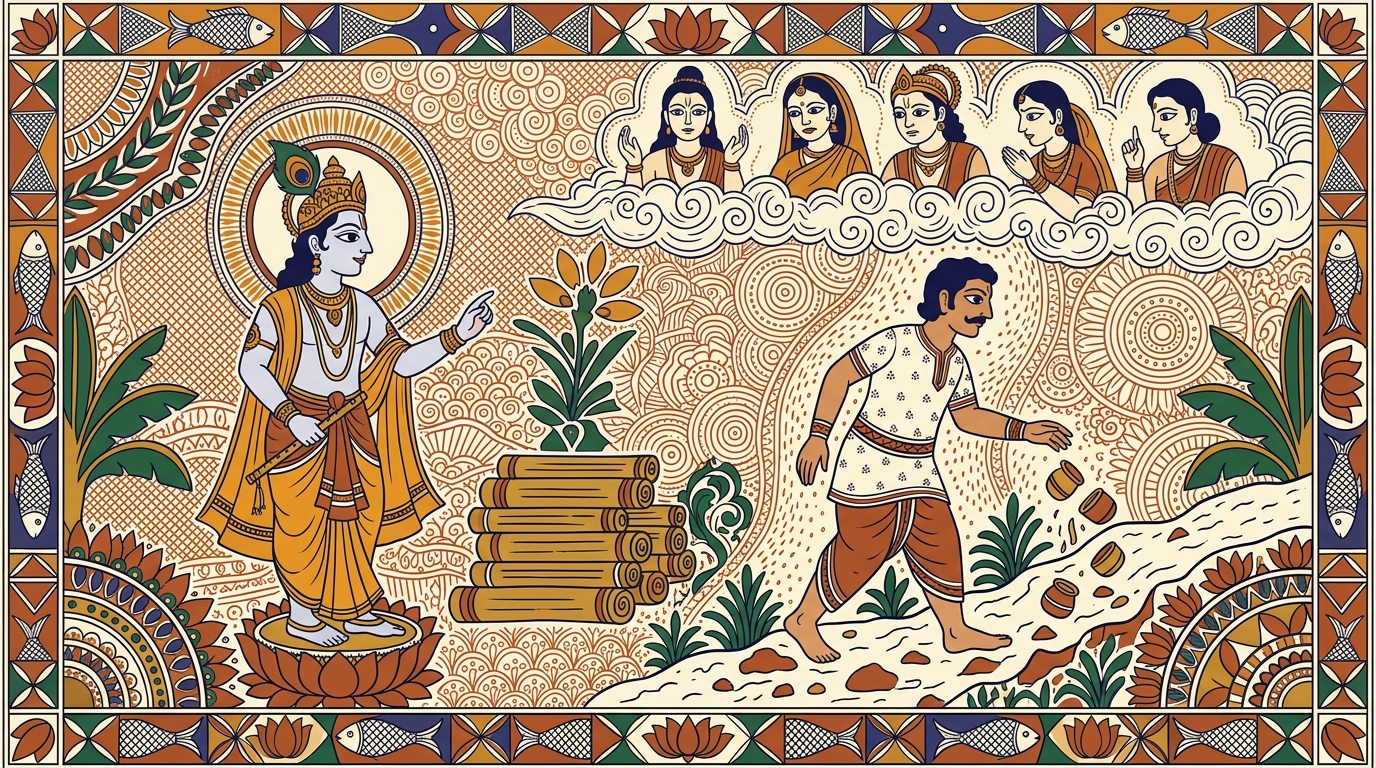
Ravana, the king of Lanka, was no fool. People forget that. He was learned,
deeply learned. He had studied the scriptures until he could recite them
backward. He knew, word for word, what the wise teachings said about how a
good person should live: rule with fairness, take what is yours and not what
belongs to others, master your desires before they master you.
Ravana knew all of it. And one day he set all of it aside.
He had seen Sita, the wife of Rama, and desire rose up in him like a great
wave. Some quiet voice — the voice of everything he had ever studied —
whispered, "She is not yours. This is wrong. Turn back." But Ravana had grown
used to doing whatever he wanted, the instant he wanted it. He pushed the
voice aside. "I am the mighty king of Lanka," he told himself. "Why should
rules bind me? I will simply take what I desire."
So he carried Sita away across the sea, against everything he knew to be right.
And here is the strange, sad part. Ravana had a golden city. He had power no
one could match. He had every pleasure a king could imagine. Yet from the
moment he followed his desire instead of his wisdom, he had no peace at all.
Sita would not even look at him. His own brother begged him to do the right
thing and was banished for it. His golden halls filled with worry. The mighty
king paced his palace at night, restless and afraid, holding everything he
had ever wanted and enjoying none of it.
He did not gain success — his great kingdom crumbled. He did not gain
happiness — he had never been more miserable. And he did not reach any high
or noble end.
Krishna told Arjuna of such men so he would understand: knowing the wise
teaching is not enough. Ravana knew it perfectly and threw it away the one
time it mattered, and chased his desire instead. The teachings had been a
hand-rail on a cliff-edge the whole time. Ravana let go of the rail because
it felt freer to let go. He found out, too late, what waits at the bottom of
a cliff.