There was once a boy whose father was the most powerful king in all
three worlds — and the most dangerous.
Hiranyakashipu had conquered heaven, pushed the gods from their
thrones, and made the oceans tremble when he walked. Every creature
bowed before him. Every creature except one — his own son, Prahlada,
five years old, with wide dark eyes and a voice as clear as a temple
bell, who refused to say his father was God.
"Who do you worship?" the king roared, his golden armour catching the
torchlight.
"Narayana," Prahlada answered. Quietly. The way you might answer a
question about your favourite colour.
The king tried everything. He ordered his soldiers to throw Prahlada
from the top of the tallest cliff in the kingdom. The boy fell — and
landed softly, as if the air itself had cradled him. He did not
celebrate. He did not laugh at the soldiers who stood at the cliff's
edge with their mouths open. He sat down in the dust, closed his eyes,
and whispered: "Narayana."
The king sent poisonous snakes — cobras with hoods spread wide as
lotus leaves. They slithered toward the boy in a hissing tide. Prahlada
sat still. The snakes circled him, tasted the air with their tongues,
and one by one lay down around him like sleeping dogs. When they
retreated, Prahlada did not gloat. He did not point at his father and
say, "See?" He simply opened his eyes and said: "They were tired. I
think they needed rest."
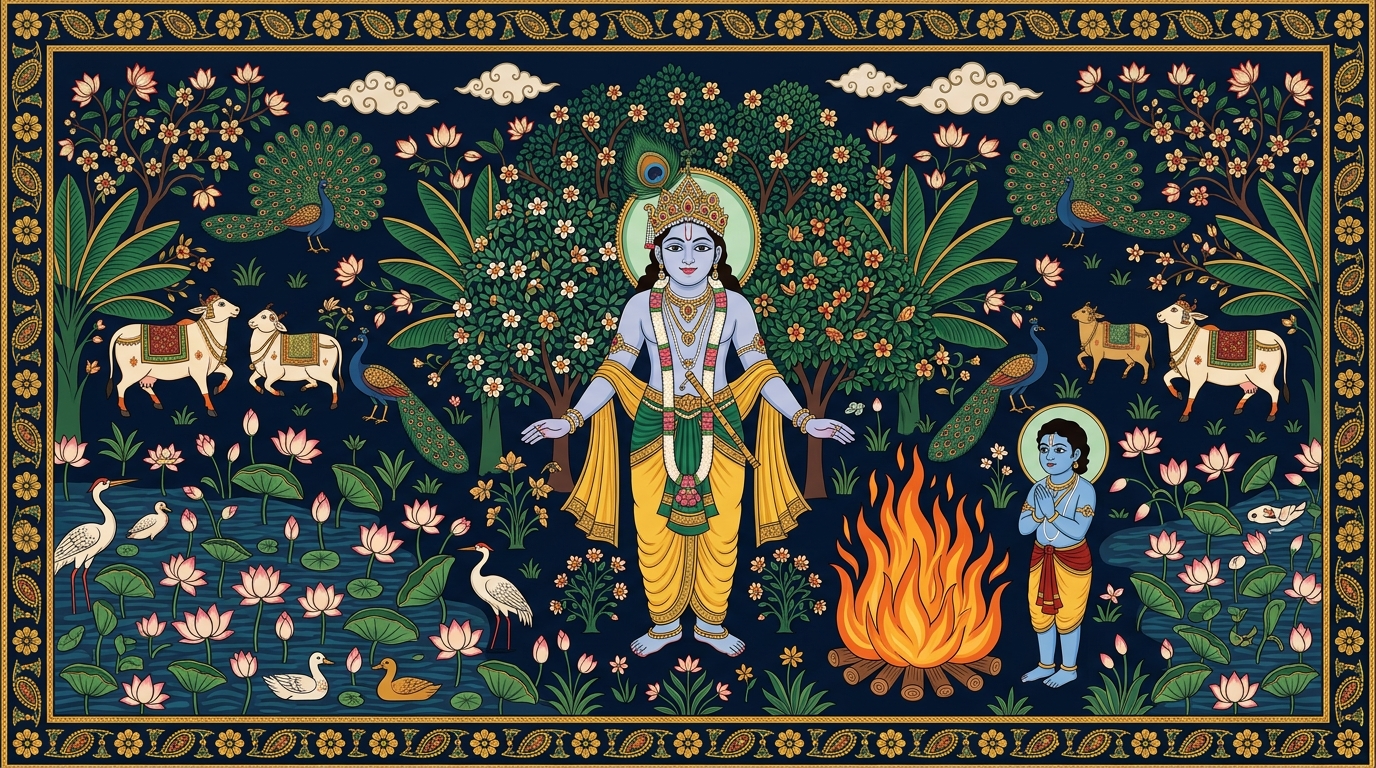
Then came the fire. Holika, the king's sister, had a boon — a magic
shawl that made her immune to flames. She carried Prahlada into a
roaring pyre, holding him on her lap, certain the fire would take the
boy and leave her untouched. The flames climbed. The heat turned the
air into a shimmering wall. The courtiers shielded their faces.
But something shifted. The shawl, as if it had a mind of its own,
flew from Holika's shoulders and wrapped itself around the boy. The
fire consumed Holika. Prahlada walked out of the ashes without a
single burn.
And here is the part that matters: he did not cheer. He looked back
at the pyre where his aunt had been, and his eyes were wet. He had
not wanted her to die. He had not wanted any of this. He was not
fighting his father. He was simply holding on to the one thing he
knew to be true, and he could not let it go — not because he was
brave, but because it was all he had.
Krishna speaks of a devotee who does not rejoice wildly when good
things happen or grieve when terrible things come. This is not
coldness. Prahlada wept for his aunt. But his centre — the quiet
place inside where Narayana lived — never moved. That stillness was
not the absence of feeling. It was a feeling so deep that nothing on
the surface could shake it.