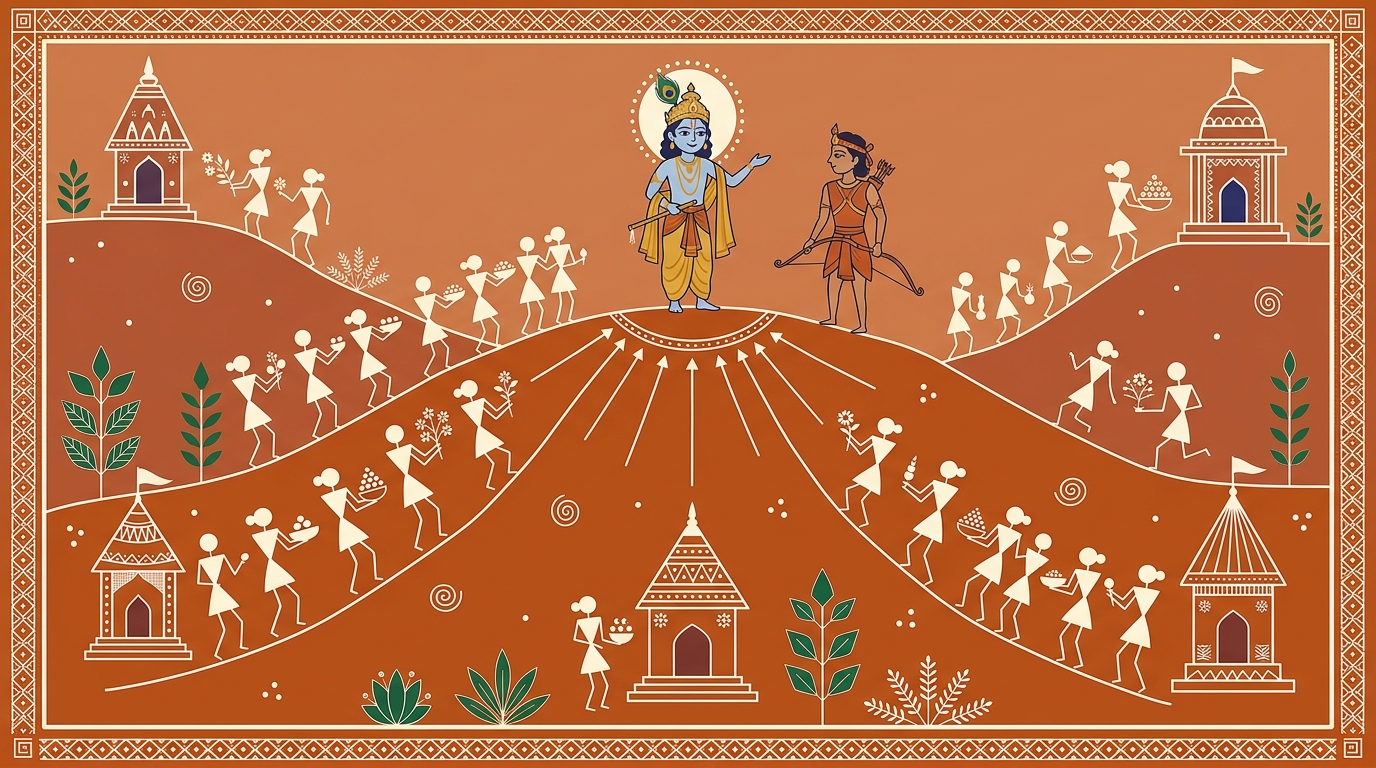
On a green hill outside an old village stood many small shrines. They had
been built over hundreds of years, one by one, by hundreds of different
hands.
Near the bottom was a shrine to the rain god, where farmers came to pray
for good monsoons. A little higher stood a shrine to the goddess of the
river, hung with little brass bells. Higher still was a shrine to the
fire, and one to the wind, and one to a kindly local guardian whose name
only the oldest grandmothers remembered. Each had its own keeper, its own
lamp, its own song.
A traveling sage once climbed the hill at dawn to rest, and he sat at the
very top and watched the village wake. As the sun rose, the people came
out and climbed to their shrines. The farmers prayed to the rain god,
their hands pressed together, their faces full of trust. A young mother
rang the river goddess's bells and whispered a wish for her sick child.
An old man tended the fire shrine, feeding it twigs, murmuring the words
he had spoken every morning of his long life.
A boy sitting beside the sage frowned. "They all pray to different gods,"
he said. "Which one is right?"
The sage smiled and pointed up — not at any shrine, but at the open sky
above all of them. "Watch where the prayers go," he said.
The boy looked. The morning smoke from every shrine — the rain god's,
the river goddess's, the fire's — rose up and up, and high above the hill
it all blended together into one soft haze and drifted into the same vast
sky.
"Each one calls a different name," said the sage. "Each one bows at a
different stone. But faith is faith. A true prayer cannot get lost. It
rises past every shrine and reaches the One who holds all the shrines
and all the gods and the whole hill in His hand. They are all praying to
Him, the boy and the mother and the old man — even the ones who do not
yet know His real name. Their love does not miss. It only does not know
where it lands."
The boy looked at the single sky holding all the smoke, and slowly began
to understand.