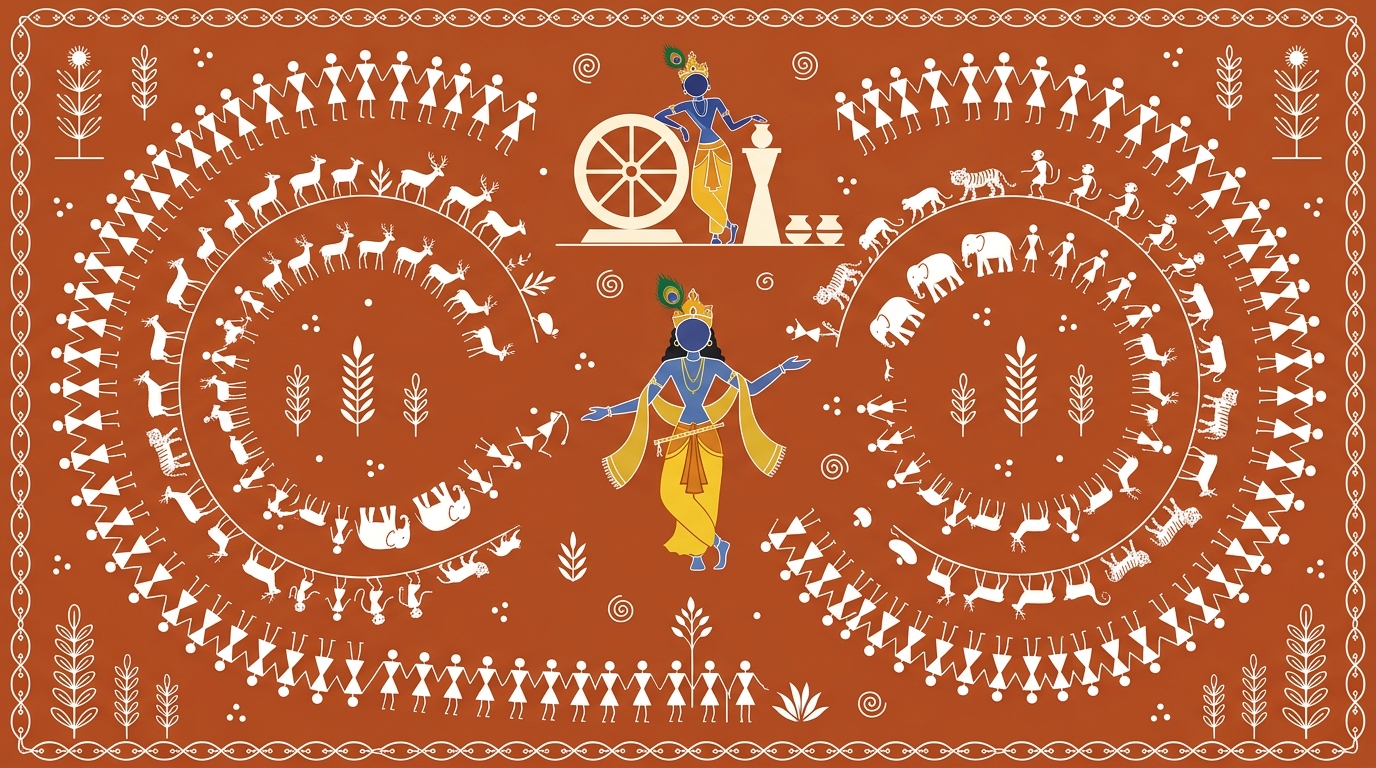
In a village beside a slow brown river there lived a potter so old that no
one could remember a time before him. His name was forgotten; people simply
called him Kumbhakara, the maker of pots.
Every morning, before the cows were let out, he sat down at his great stone
wheel. He set one bare foot against it and gave it a spin. Round and round
it went, humming, and from the wet grey clay his hands drew up a pot, then
another, then another. By evening the drying yard was full of them: water
jars, lamps, little bowls, tall vessels for grain.
A boy named Aru came every day to watch. One evening he asked, "Grandfather,
don't you ever get tired? You make pots and pots and pots, and tomorrow you
will make more."
The old potter laughed without stopping his hands. "Tired? Why would I be
tired? Look." He tapped the heavy stone wheel beneath his palm. "I do not
push and strain. I lean on the wheel. The wheel does the turning. The clay
does the rising. I only rest my hands upon what is already moving, and the
pots come out, one after another, as many as the world needs."
Aru watched the spinning wheel and the calm hands.
"And the pots," the potter went on, "do they choose to become pots? No. The
spinning carries them up. They are shaped by the turning, helpless and
happy, into exactly what they are meant to be."
That night Aru lay awake thinking. He had heard the temple sages say that
the Lord makes the whole world this same way — resting upon His own great
power, sending out being after being, age after age, never tiring, never
forcing. The wheel of nature turns, and out come the stars, the rivers, the
animals, the people, helpless in the best way, like soft clay rising into
shape under a master's quiet hands.
In the morning Aru ran back to the potter's yard. The old man was already
seated, one foot on the wheel, a fresh lump of clay between his palms.
"Again?" Aru asked, grinning.
"Again," said the potter, "and again, and again," and the wheel began to
hum.