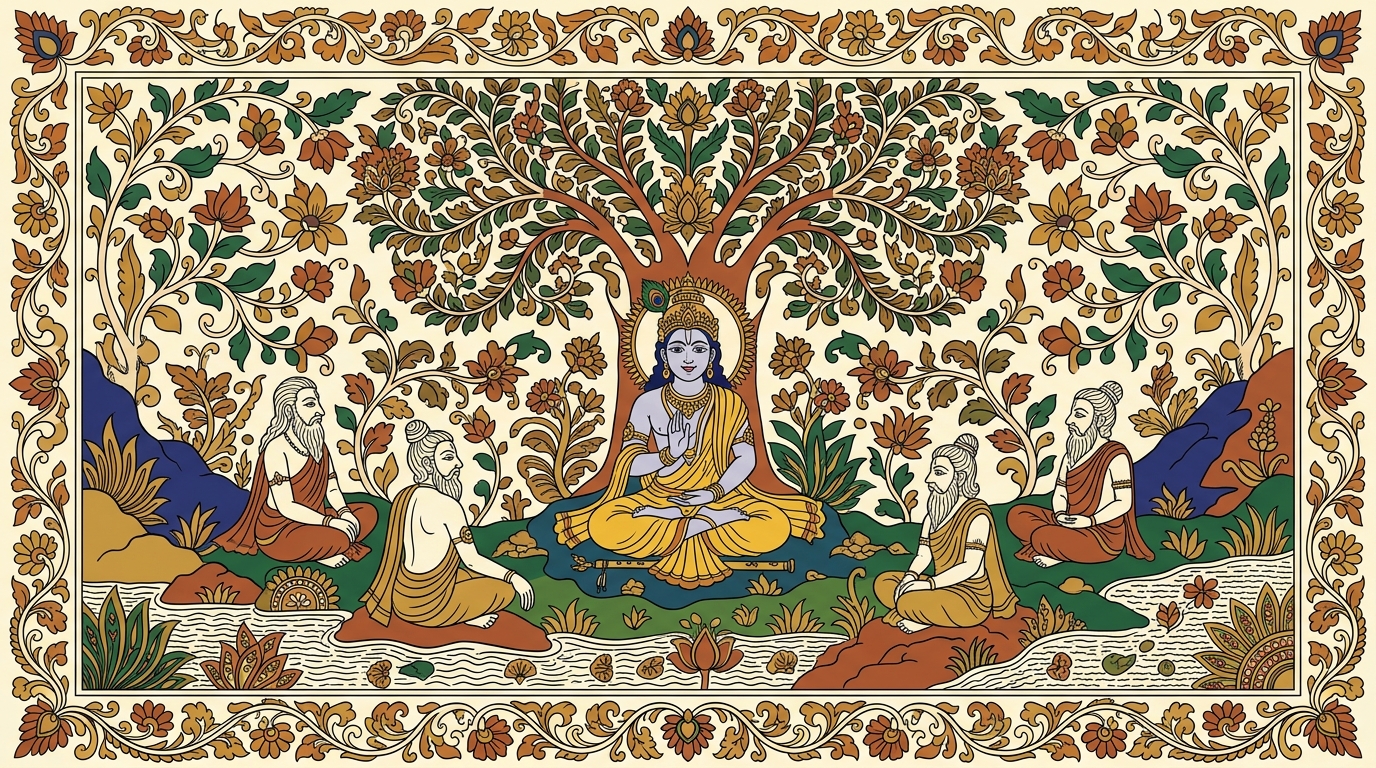
Krishna spoke softly now, and Arjuna leaned in to hear over the
restless stamping of the horses.
"Let me tell you of two houses," Krishna said.
"The first house had many windows. All day its rooms were bright,
for the sun poured in from every side. The family who lived there
was cheerful — when the sun shone. But on grey mornings the rooms
went dim, and the people grew dim with them. When clouds came, they
quarreled. When evening fell, they fell quiet and sad. Their light
was borrowed, you see. It came from outside, and so it could be
taken away."
A breeze stirred the mist across the battlefield.
"The second house had a lamp. Just one, set in the very center of
the home, and it was never allowed to go out. The windows of this
house could be shuttered against a storm, and still the rooms glowed
warm and gold. Travelers lost in the dark would see that light from
far off and know that someone was home — truly home — no matter the
weather, no matter the hour."
Arjuna pictured it: a single steady flame in the heart of a quiet
house.
"The yogi," said Krishna, "is the second house. His happiness is not
a window that the sun fills and the clouds empty. It is a lamp he
carries within. He delights inside himself; he rests inside himself;
he is lit from inside. So when the world turns grey — when battles
are lost, when friends go away, when the night comes — his light does
not flicker."
"And such a person," Krishna went on, "settles at last into the
vast quiet that holds all things, the way a flame settles when the
wind dies. We call it the peace of Brahman. It is not a place far
away. It is what you become when your light no longer depends on
anything outside you."
Arjuna said nothing, but his shoulders, which had been hunched all
morning, eased a little.
"Find the lamp within, Arjuna," Krishna said, "and you will never
again be at the mercy of the weather."