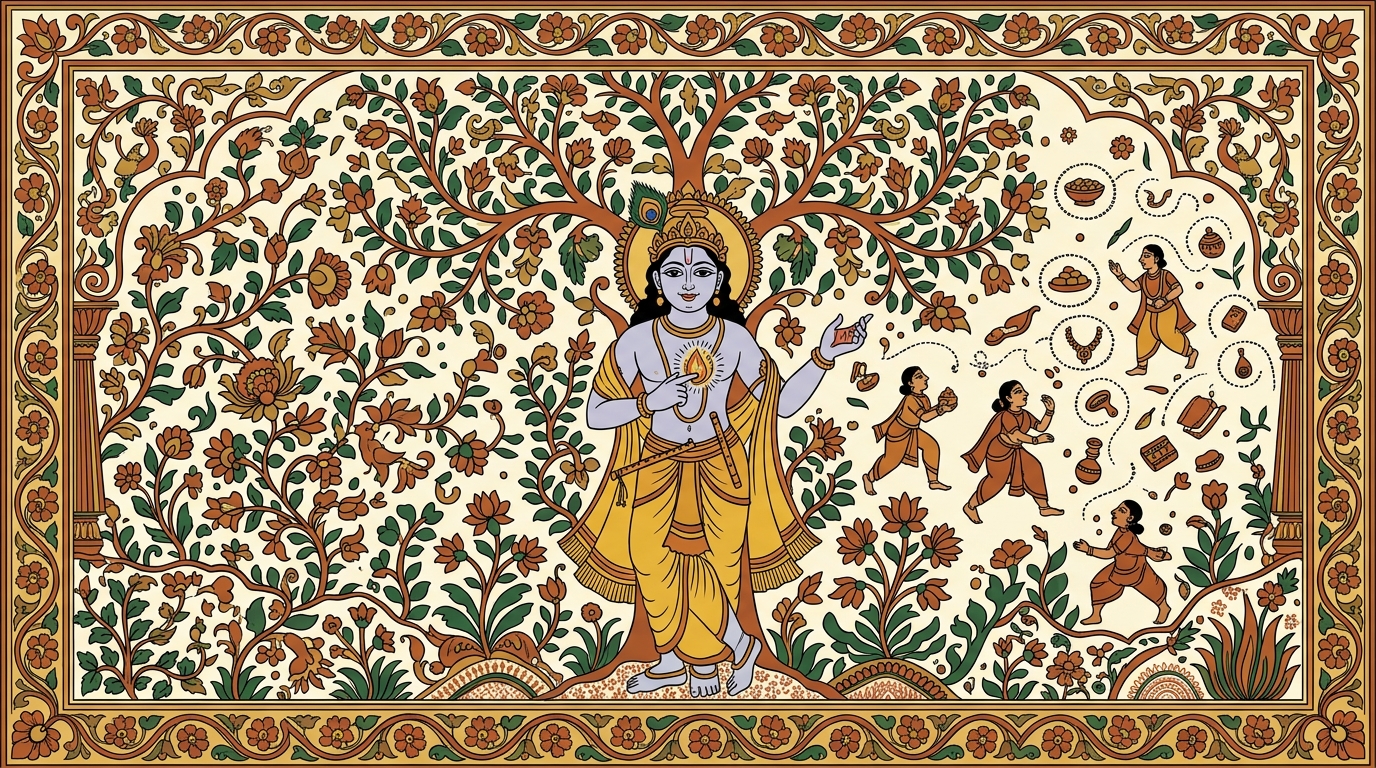
Two brothers grew up beside the same dusty road that led to Kurukshetra,
and they grew up very differently.
The elder, Madhu, loved sweets above all things. Each day he spent every
coin he had at the sweet-seller's stall — golden jalebis, syrup-soaked
laddus, sticky barfi. The sweetness was wonderful. But it was always
over too fast. By the time he licked the last of the syrup from his
fingers, the joy had already drained away, and he was left wanting more,
hungrier than before. He spent his life chasing the next bite, and the
bite after that, never full for long.
The younger, Niru, noticed something. Behind their house, half-hidden by
ferns, was a spring of cool, clear water that bubbled up out of the rock.
It cost nothing. It was always there. He learned to sit beside it in the
evenings, drinking when thirsty, listening to it murmur. The spring never
dazzled him the way a fresh laddu dazzled Madhu, but it also never ran
dry, and it never left him emptier than before. Slowly Niru grew calm and
content in a way his brother never managed, no matter how many sweets he
bought.
"How are you always so settled?" Madhu finally asked, wiping syrup from
his chin.
"Your sweetness comes from outside, and the outside always runs out," Niru
said. "Mine comes from the spring, and the spring is already here. I
didn't have to buy it. I only had to stop running long enough to find it."
On the war-plain, in his chariot, Krishna was telling Arjuna of that very
spring. "The one who is not stuck to the pleasures the senses chase
outside," he said, "discovers a happiness welling up inside the Self.
Joined to that, a person drinks a joy that never empties, not a treat
that ends, but a spring that does not."
Madhu looked at his sticky fingers, and then, for the first time, walked
around to the back of the house to sit by the quiet water.