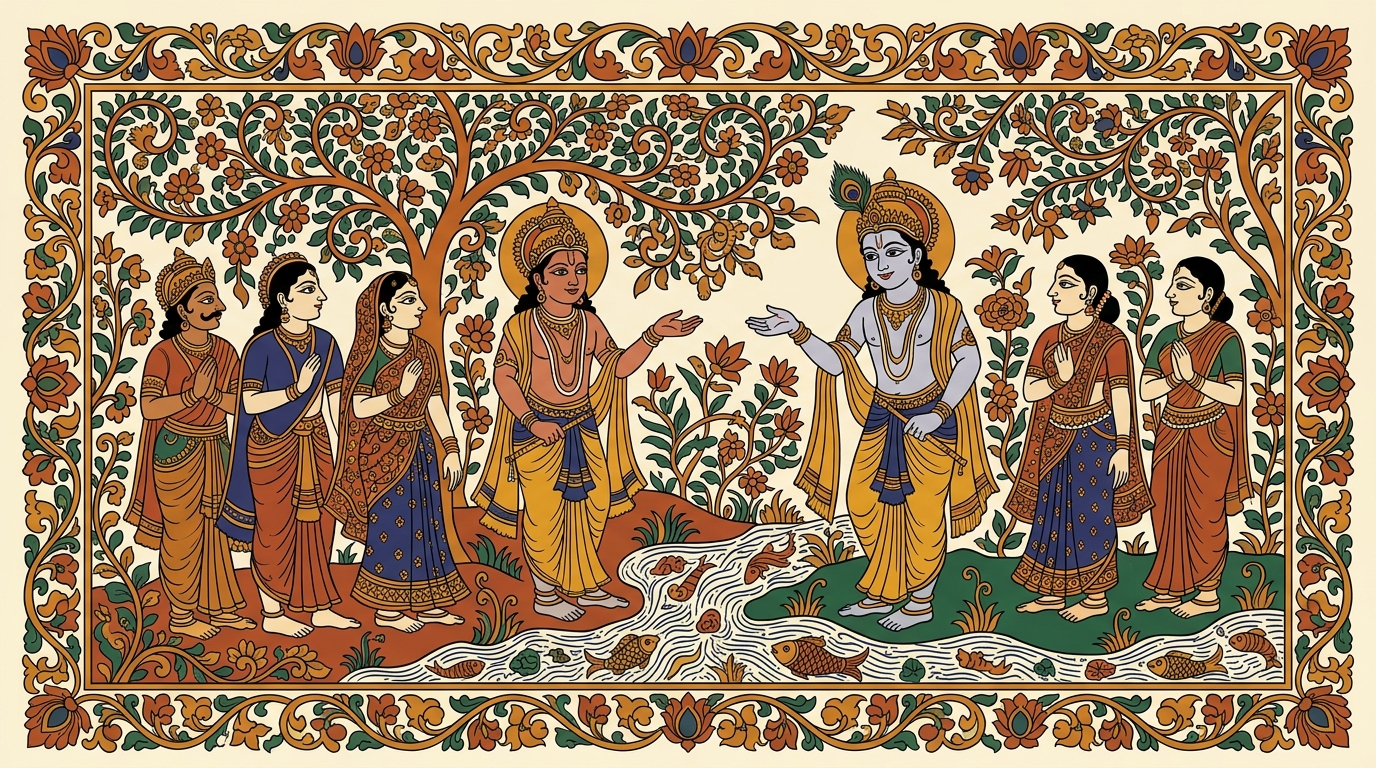
High in the mountains there was a spring, and the children of the village
below liked to ask the old shepherd, Bhadra, where the river came from.
"Does the mountain push the water down?" asked a small girl named Sita.
"Does it shove the river along, the way you push a cart?"
Bhadra laughed and sat them all on a flat warm rock. "Come and look," he
said, pointing to the stream as it tumbled past. "Watch how it moves.
Does anything seem to be pushing it?"
The children watched. The water rushed and curled and leapt over stones,
bright and quick. But there was no hand on it, no shove, no master driving
it forward.
"Then why does it run?" asked Sita.
"Because of its own nature," said Bhadra. "Water flows. That is simply
what water is. The mountain does not stand over the river ordering it to
hurry. The mountain only holds still and lets the riverbed be a riverbed.
The water does the rest, all by itself, following the slope that is already
in it."
He pointed to where the stream split — one part racing down a steep cut,
another spreading slow and calm across a meadow. "See? The fast part is
not fast because the mountain chose it. It is fast because the ground
there is steep. That is its nature. And the slow part is slow because
the land is flat. The mountain creates neither the hurry nor the calm. It
simply lets each be what it is."
Sita frowned, thinking hard. "So when I run and laugh and can't sit still
— that's my nature? Nobody is making me?"
"Nobody from outside," said Bhadra gently. "The great One who holds the
world is like the mountain. He does not pour the doer-feeling into you, or
make your deeds, or tie your rewards on with string. He holds the whole
landscape steady and still, and lets each of us flow along the riverbed of
what we already are."
The children sat a long while, listening to the water run on by itself,
and the mountain behind them said nothing at all, which was exactly how it
let everything move.