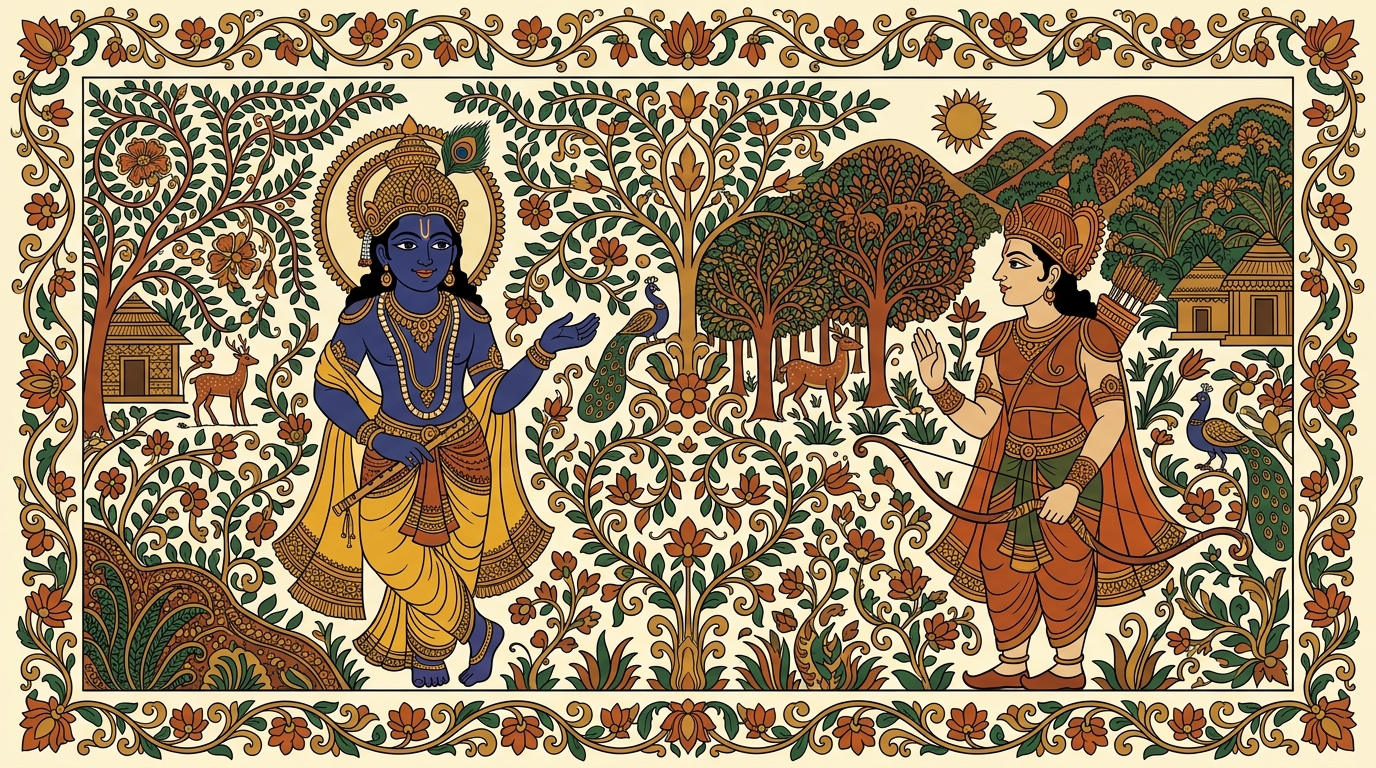
"There was a young man once," Krishna said, "who decided he would become
holy all at once. His name was Sumant."
Arjuna tilted his head, listening.
"Sumant had heard that the greatest sages give up everything and sit
perfectly still. So one morning he set down his tools, walked into the
forest, found a smooth rock, and sat upon it, determined to be done with
the world by sundown."
A horse snorted, as if amused.
"But Sumant had never practiced anything. He had never learned to do a
single task without grumbling, never carried water without wishing he were
elsewhere, never finished a chore without sulking about the reward. So when
he sat on his rock, his mind would not sit with him. It ran back to the
village. It itched for praise. It worried over his empty stomach. By midday
his legs ached, his thoughts roared, and the stillness he had hoped for was
nowhere to be found. He was more restless on the rock than he had ever been
at his work."
"So he failed?" Arjuna asked.
"He learned," said Krishna. "An old sage passed by and saw him fidgeting.
'You have tried to carry a full bowl,' the sage said, 'before you ever
learned to hold an empty one. Go back. Do your tasks — but do them without
grabbing at the reward. Carry the water gladly. Sweep the floor gladly.
Let go of the fruit each time. When your hands have learned that thousands
of times, your mind will sit down all by itself.'"
Krishna looked at Arjuna.
"Sumant went back. He worked, and worked lightly, releasing the reward each
day. And one quiet evening — he could not say which one — he found that the
stillness had come to him on its own, like a bird that lands only when you
stop reaching for it."
"So acting first," Arjuna said slowly, "makes the stillness possible."
"It clears the path," said Krishna. "Do your work well, and the great peace
will not be far behind."