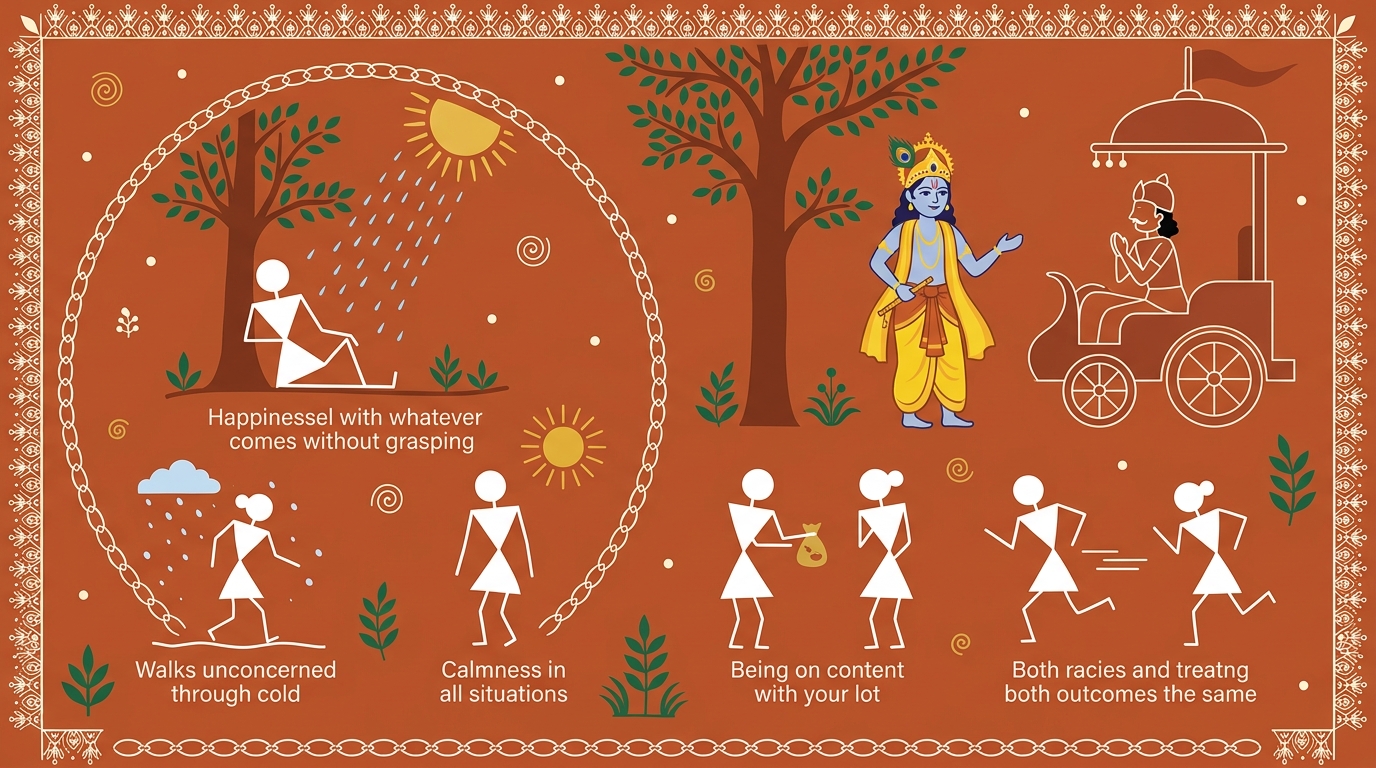
On the slow bend of a river near the camps, there lived a boatman named
Devala. Krishna once spoke of him to Arjuna while the horses drank at the
water's edge.
"Every morning," Krishna said, "Devala pushed his boat from the bank and
asked the river for nothing. Some days travellers came and filled his boat
with coins. Some days no one came at all, and he ate only the rice he had.
He did not chase the busy days or sulk through the empty ones. He simply
rowed."
Arjuna listened, watching the current pull at the reeds.
"One summer," Krishna went on, "the heat cracked the mud and the river
shrank to a thread. The next monsoon it swelled so wide it swallowed three
fields. Heat and flood, drought and storm — Devala met them all with the
same steady arms. He did not curse the sun, and he did not boast about the
rains. To him they were two faces of the one river he had always loved."
A heron lifted off the far bank.
"There was a richer boatman downstream," Krishna said, "with a finer boat
and a brighter sail. The other villagers praised that boat often. But Devala
felt no sting when they did. He looked at the fine sail the way he looked at
a cloud, something pretty passing by, no concern of his. There was no room
for envy in a heart already full."
"And his work?" Arjuna asked.
"He worked hard. He rowed against currents that would tire a strong man. He
repaired his boat and carried heavy loads. Yet the work never owned him.
When a crossing went well, he did not swell with pride. When a passenger
slipped and the coins fell into the water, he did not break with grief. He
untied his boat each dawn and tied it each dusk, and in between he was free."
Krishna turned the reins gently in his hands.
"That, Arjuna, is the secret. It is not that Devala did nothing. He did a
great deal. But he took each gain as it floated to him, stayed level through
every opposite, envied no one, and weighed success and failure on the same
quiet scale. So the rope of his work never tightened around him."
The river moved on, indifferent and kind, the way it always had.