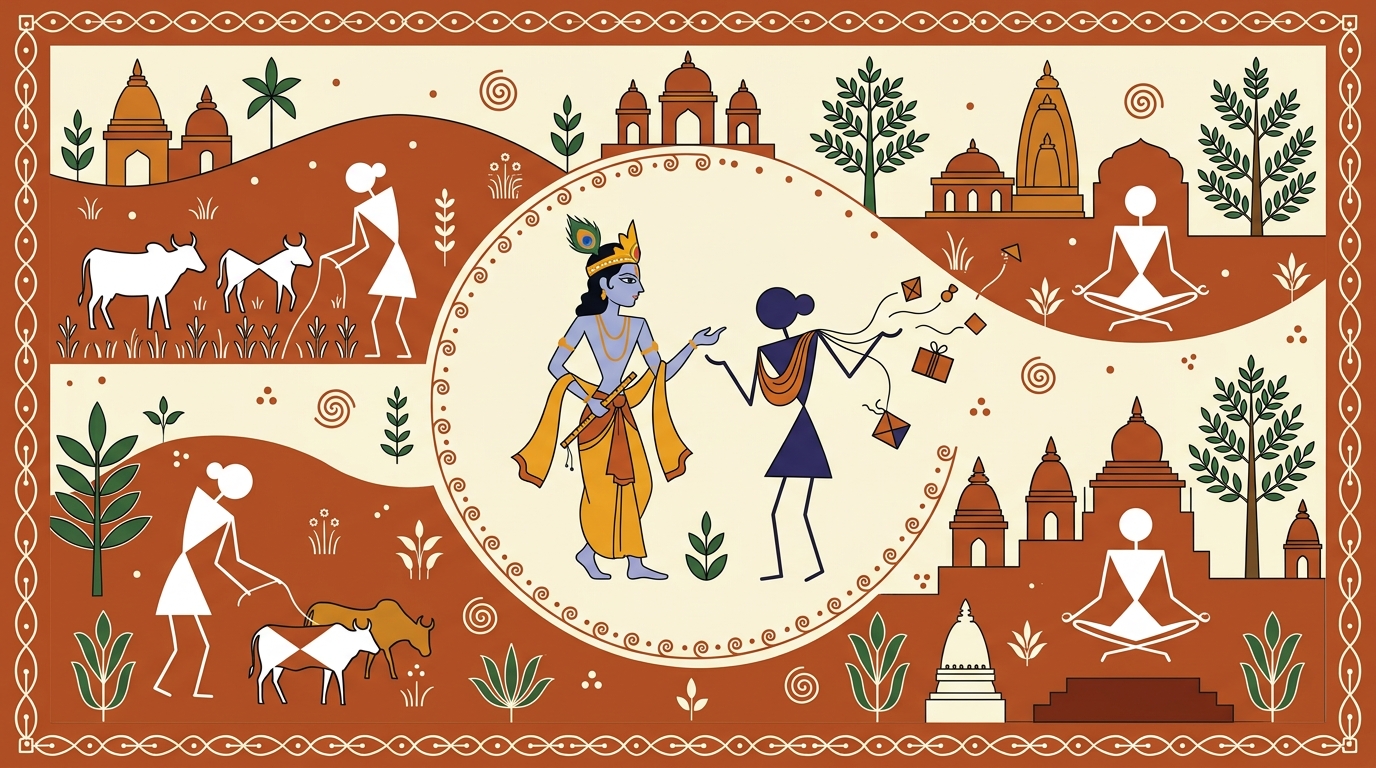
"There is a kind of freedom," Krishna said, "that you can carry with you
even when your hands are full."
Arjuna looked down at his own hands, calloused from years of holding a
bow.
"Once," Krishna went on, "I knew a gardener who tended the grounds of a
great temple. From sunrise he worked: pulling weeds, carrying water,
trimming the flowering vines, sweeping the stone paths until they shone.
He never stopped moving. A traveller watching him might say, *what a
busy man, what a heavy load he carries.*"
"But here was his secret. The gardener had long ago let go of grabbing
at the fruit of his work. He did not toil for praise. He did not fret,
*will the master thank me, will I be paid more, will people admire my
roses.* He simply did the work in front of him, well and gladly, and
then let it go."
The cooking fire across the field had burned down to glowing coals.
"And because he wanted nothing in return," Krishna said, "he was always
content. Each day was already enough. He did not need to lean on this
reward or that compliment to feel whole. He leaned on nothing, depended
on nothing, and so nothing could knock him over. Praise did not puff him
up. Scorn did not crush him. He was free."
Arjuna frowned, puzzled. "But he worked from dawn to dusk. How can you
say he was free of work?"
"Ah," said Krishna. "His body worked, yes. But inside, where it truly
matters, he was so unburdened, so untroubled, so utterly at peace, that
it was as if he did nothing at all. The work passed through him like
water through open fingers. It never stuck. It never weighed him down.
Though he was busy from morning to night, in his heart he carried no
heavy load."
Krishna looked out at the waiting armies.
"That is the freedom I want for you, Arjuna. Not empty hands — but hands
that stay free even while they are full."