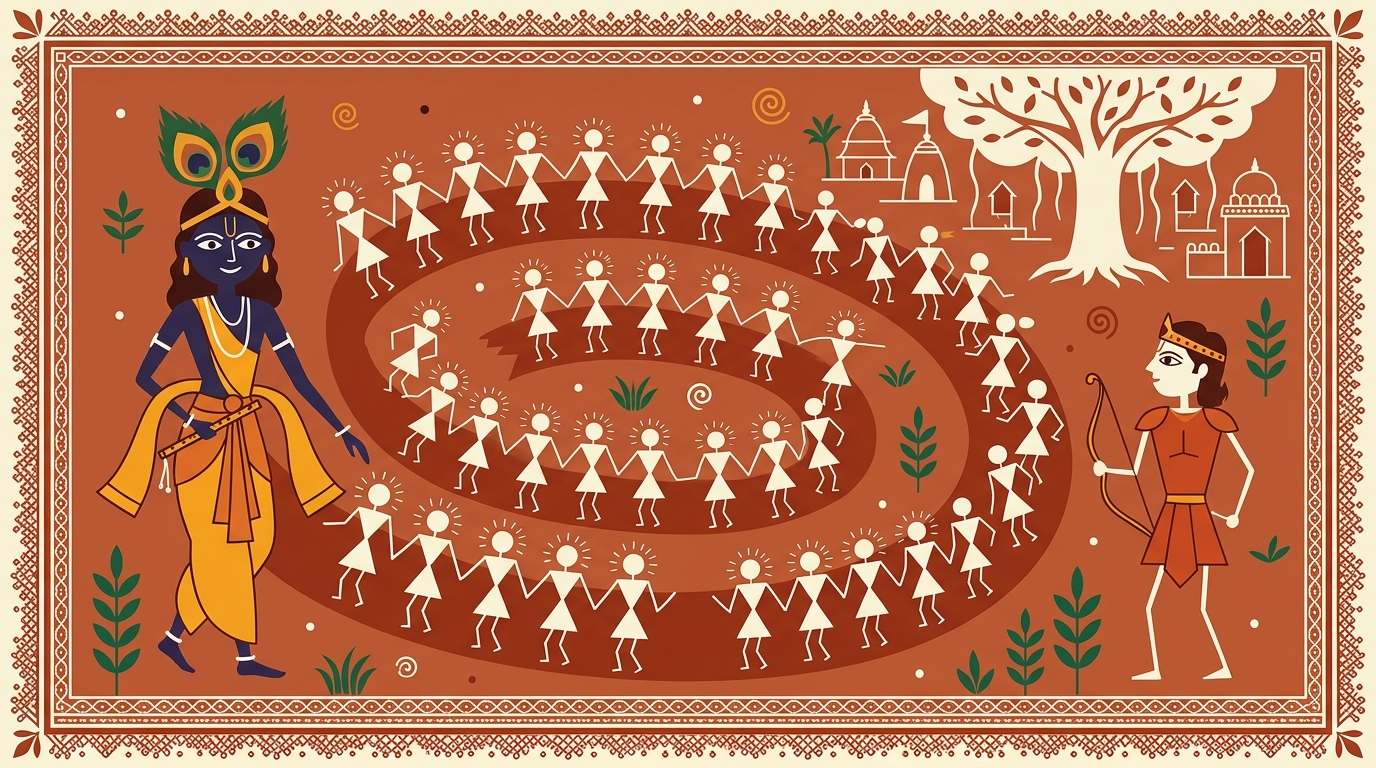
Arjuna had imagined himself alone. Alone with his grief on the morning of
the war, alone with the impossible choice. So Krishna's next words
surprised him.
"You are not the first to stand where you are standing," Krishna said.
"And you will not be the last. Many have walked this road before you,
Arjuna. Many."
"Many?" Arjuna echoed.
"Picture a great pilgrimage," said Krishna. "A road winding toward a
mountain temple. At the start, the travellers are heavy. One carries a
sack of grudges. One carries a knot of fear in his chest, tight as a
fist. One carries an old anger that flares up at every small thing, like
a coal that will not cool. They limp and stumble under all of it."
The horses shifted. Krishna watched the imagined road in his mind's eye.
"But the climbing changes them. Step by step, the craving that says *I
must have, I must have* loosens its grip and slips off the shoulder.
The fist of fear unclenches. The hot coal of anger, with no one to feed
it, slowly goes grey and dark. And what makes this happen? Not magic.
The warm, steady heat of real understanding, the way the sun's heat
dries a wet cloth, gently, completely."
He spread one hand toward the field, but he seemed to be pointing past
it, past the army, into time itself.
"By the time those travellers reach the temple, they are light. They are
clean, the way a stone in a river is clean. They had filled their thinking
with me, leaned on me when the path was steep, taken shelter in me when
the storms came — and so they arrived not as strangers at the door, but
as ones who already shared in my own nature. Many of them. More than you
could count."
Arjuna looked out at the vast, frightened field, and for the first time
that morning he did not feel quite so alone.
"Then the road is well worn," he said.
"Worn smooth," said Krishna, "by countless feet that learned to set their
burdens down."