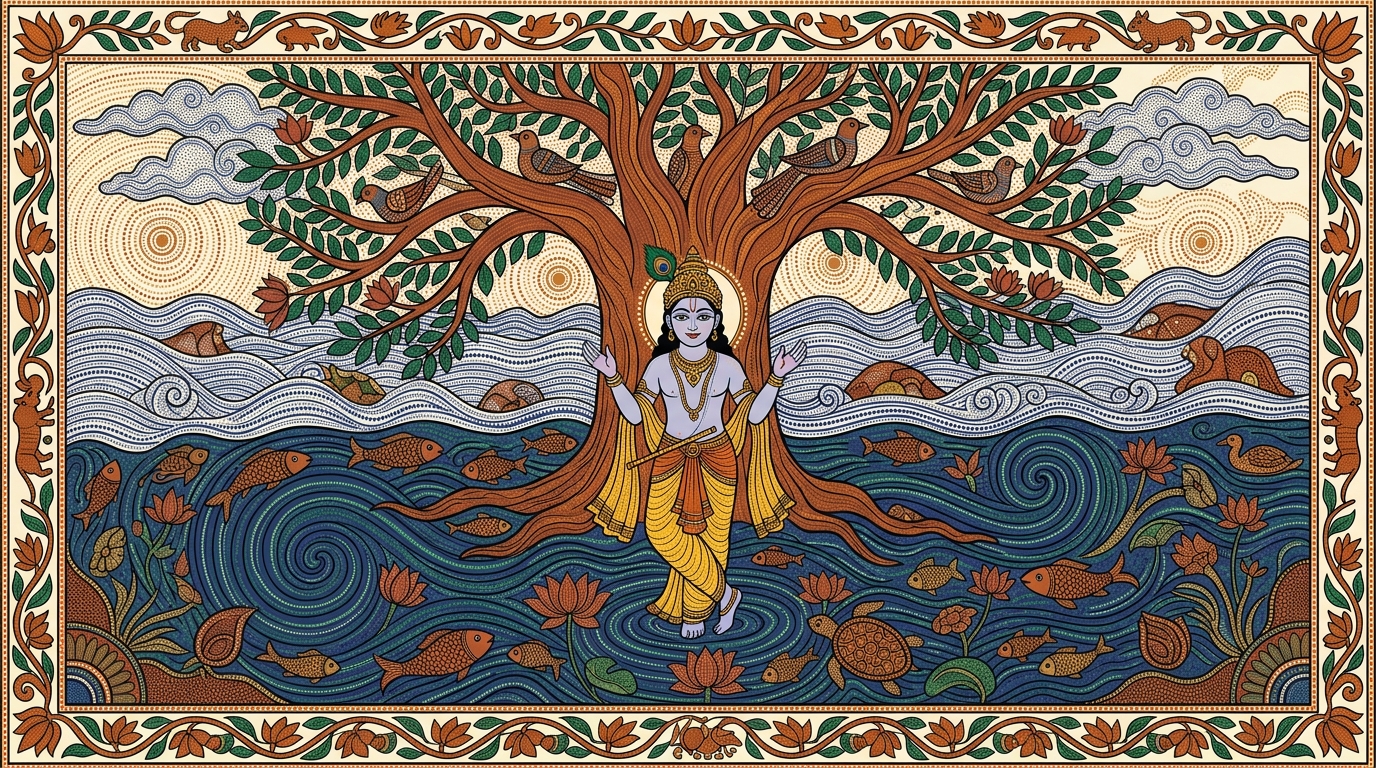
There was a lake at the foot of the Vindhya mountains that the
villagers called Shantisagar — the Ocean of Peace. It was not an
ocean, of course. It was a small, round lake, no wider than a
cricket pitch, fed by underground springs and shaded on three sides
by ancient banyan trees whose roots hung down into the water like
the fingers of sleeping giants.
For most of the day, the wind blew across the lake's surface, and
the water was restless — wrinkled, choppy, flashing with fragments
of reflected sky and cloud and leaf. If you stood on the bank and
looked down, you saw only a churning mosaic of broken light. You
could not see the bottom. You could not even see your own face.
But every evening, as the sun dropped behind the Vindhyas and the
air went still, something extraordinary happened. The wind died. Not
gradually — it simply stopped, as though someone had closed a door.
And the lake, which had been trembling and twitching all day, went
absolutely flat.
In that stillness, the water became a mirror, not a bathroom mirror
with its streaks and smudges, but a perfect mirror, so clear that
the reflected sky was indistinguishable from the real one. Birds
flying overhead appeared to be flying below, in a second sky beneath
the water's skin. The banyan roots, the stones on the bottom, the
slow gliding of a silver fish — everything became visible, all the
way down.
The old grandmother who lived near the lake — people called her
Shanti-ma, though no one knew if that was her real name — would sit
on the bank every evening at this hour. When curious visitors asked
what she was looking at, she always said the same thing: "I am
watching the lake remember what it really is."
Krishna is describing this moment. When the mind becomes serene,
genuinely settled and not merely distracted from its agitation,
something happens that cannot happen any other way. The
sorrows do not leave because someone pushed them out. They dissolve
the way turbulence dissolves from water when the wind stops. They
were never solid things. They were disturbances, patterns of
movement, and when the movement ceases, they simply are not there
anymore.
And in that clarity, the intellect becomes steady. Not clever —
steady. Cleverness is a restless kind of knowing, always reaching
for the next thought. Steadiness is knowing that settles into itself
like water settling into a lake, clear and deep and reflecting
everything without holding anything.
Arjuna listened, and for a moment the battlefield and the armies and
the terrible decision before him seemed very far away, like a
landscape seen through the wrong end of a telescope. There was just
this: a still lake. A clear sky. The feeling that if he could only
be still long enough, he might see all the way to the bottom of
everything.