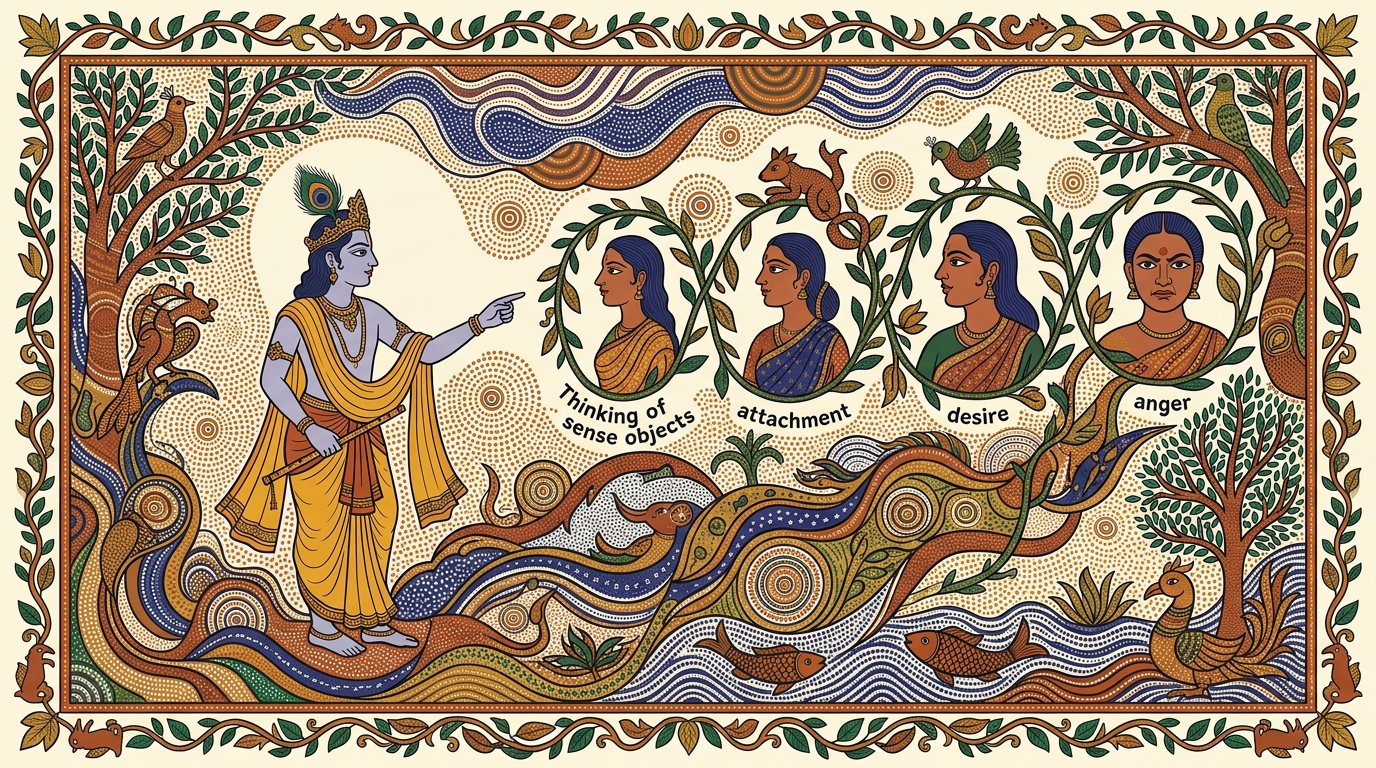
Krishna paused before he spoke these next words. Arjuna noticed
the pause. It was unusual. Krishna did not hesitate. He did not grope
for words the way ordinary speakers do. When he paused, it was because
what came next was important enough to deserve a breath of silence
before it.
"Let me show you something, Arjuna. A chain."
Not a chain of iron. A chain of the mind, forged link by link inside
a person's own head, so quietly that most people never hear the
hammering until the chain is already around their neck.
Here is the first link: a thought. Just a thought. A soldier on the
other side of the battlefield remembers the mango orchard behind his
childhood home. The mangoes in summer, gold and heavy, warm from the
sun, so sweet that the juice ran down his wrists. Just a memory. Just
a picture in the mind. Harmless.
But the thought stays. He thinks about it again. And again. And each
time, the picture grows a little brighter, a little warmer, a little
more real. This is the second link: attachment. The thought has become
sticky. It clings. The soldier is no longer just remembering the
mangoes — he is holding onto the memory, turning it over and over
like a coin in his pocket. The orchard is no longer a picture. It
is a place he needs to return to.
From that attachment, the third link is forged: desire. Need. He
must have those mangoes. He must go back to that orchard. Not
someday — now. The wanting fills his chest like water filling a cup,
rising toward the brim.
And then — the cup overflows. Because wanting something desperately
and not having it produces a heat, a friction, a pressure that has
only one name: anger. At what? At anything. At the battle that keeps
him from the orchard. At the commander who gave the orders. At the
gods who made a world where you cannot always have what you want.
Thought. Attachment. Desire. Anger. Four links, each one born from
the one before, each one stronger than the last. And it all started
with a mango.
"Do you see?" Krishna said. "The chain does not begin with anger. No
one wakes up angry. The chain begins with a single unguarded thought
— a thought that was allowed to stay too long, to put down roots, to
grow from a seed into a vine that wraps around the mind and squeezes."
Arjuna looked at his own hands. How many chains had he forged without
knowing? How many stray thoughts had he let stay too long?
The battlefield hummed. The wind carried the smell of dust and horses.
Somewhere a conch shell sounded, distant and lonely. And Arjuna
listened as Krishna traced the next links in the chain — the ones
that lead all the way down to ruin.