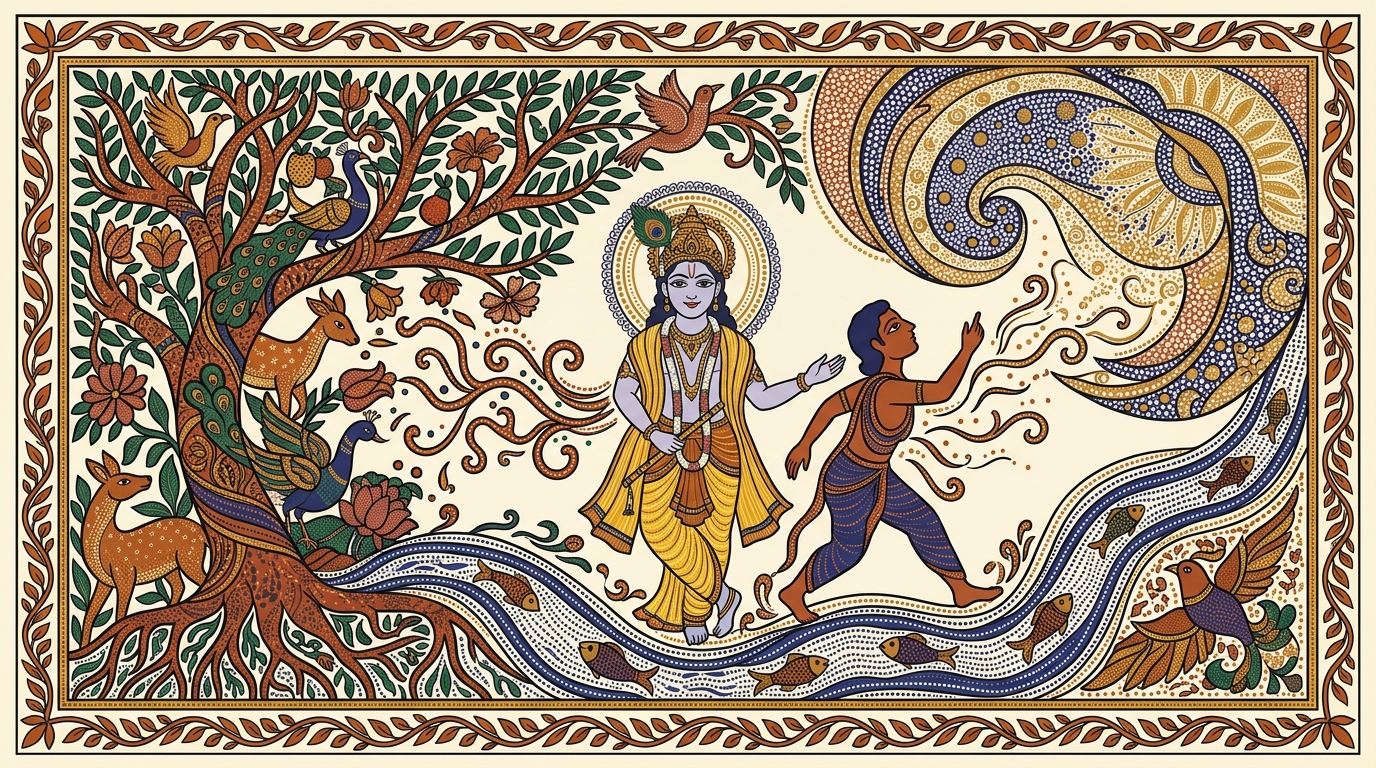
There was a rishi named Dadhichi who lived at the edge of a great
forest, near the banks of the Saraswati river. He had given up
everything — his home, his possessions, his comfortable life in the
city — and lived on roots, wild fruit, and water from the river. His
body had grown thin and hard as rope. His eyes were clear as
mountain pools.
But there was a problem. Every evening, when the wind shifted and blew
from the east, it carried the smell of cooking from a village across
the river. Ghee sizzling in iron pans. Rotis puffing on open flames.
The sweet, warm perfume of kheer simmering with cardamom. The smell
reached Dadhichi like a hand reaching through a window, and each time,
something inside him stirred — not hunger exactly, but the memory of
hunger. The ghost of a craving he thought he had already buried.
He did not eat. He did not waver. But the stirring was there,
persistent as a cricket in the wall that will not stop singing. The
objects had gone. There was no plate before him, no spoon, no feast.
Yet the taste of wanting remained, faint but stubborn, like the
outline of a word erased from a slate that you can still read if you
tilt it toward the light.
Dadhichi sat with this for many months. He did not fight the feeling.
He did not pretend it was not there. He simply watched it, the way you
watch a cloud cross the sky — present, real, but passing.
Then one evening, during his meditation by the river, something
happened that the old texts describe but words struggle to hold. The
boundary between Dadhichi and the river dissolved. The boundary
between Dadhichi and the sky dissolved. He did not become nothing — he
became everything, or rather, he recognized that he had always been
everything, the way a wave suddenly understands it was always the
ocean.
When he opened his eyes, the wind still blew from the east. The smell
of cooking still reached him — ghee, rotis, cardamom. But the
stirring was gone. Not pushed down. Not wrestled into submission. Gone
the way a candle flame is gone when the sun rises. Not because someone
blew it out, but because something so much larger and brighter had
arrived that the tiny flame simply had no more purpose.
The taste, Krishna tells us, is the last thing to go. You can give up
the food and still taste the wanting. But when you touch something
infinite, even that ghost dissolves — not by force, but by fullness.