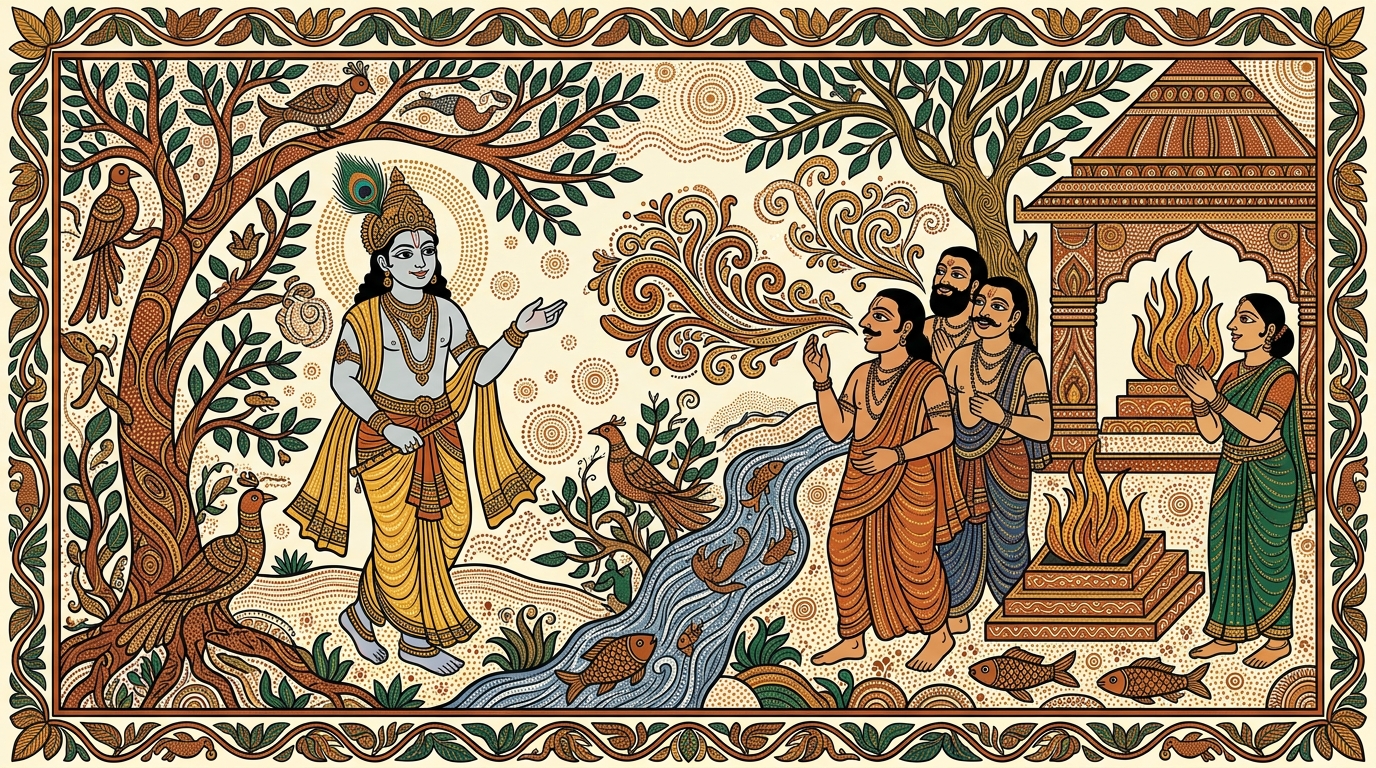
In the age before Kurukshetra, there was a priest named Vishala
who traveled from kingdom to kingdom with a cart full of scrolls.
He was not a bad man. He knew the Vedas the way a mapmaker knows
coastlines — every contour memorized, every prayer catalogued,
every ritual filed in its proper place. When he opened his mouth,
scripture poured out in perfect meter, each syllable landing with
the precision of a coin dropped into a brass bowl. Kings invited
him to their courts. Crowds gathered when his cart rolled into
the market square.
But Vishala had learned a trick.
He had noticed that people did not come to hear wisdom. They came
to hear promises. So he wrapped the Vedas in ribbons of desire.
"Perform this fire ritual," he would say, "and your fields will
yield double grain." He would lean close, his voice rich and
warm as ghee poured into flame. "Chant this mantra a thousand
times, and your son will become a king. Offer this sacrifice,
and the gates of heaven will swing open like a merchant's doors
on market day."
His words were beautiful. They bloomed like
flowers. Puṣpitāṁ vācam, Krishna would later call them. Flowery
speech. The kind that smells wonderful and weighs nothing.
People paid him in gold, in cattle, in land. They performed the
rituals exactly as he prescribed. Some received what they wanted
— a good harvest, a healthy child — and credited Vishala. Others
did not, and Vishala blamed their pronunciation, their timing,
their insufficient faith. He always had an answer. His cart of
scrolls never ran empty.
But here was the thing Vishala never taught, because it could not
be sold: the Vedas were a doorway, not a destination. The rituals
were meant to discipline the mind, not purchase results. The
prayers were meant to dissolve the ego, not inflate it. Vishala
had taken a map to the ocean and convinced people that the map
itself was water.
Krishna's warning to Arjuna was this: beware the man whose
scripture sounds like a shopping list. Wisdom is not a transaction.