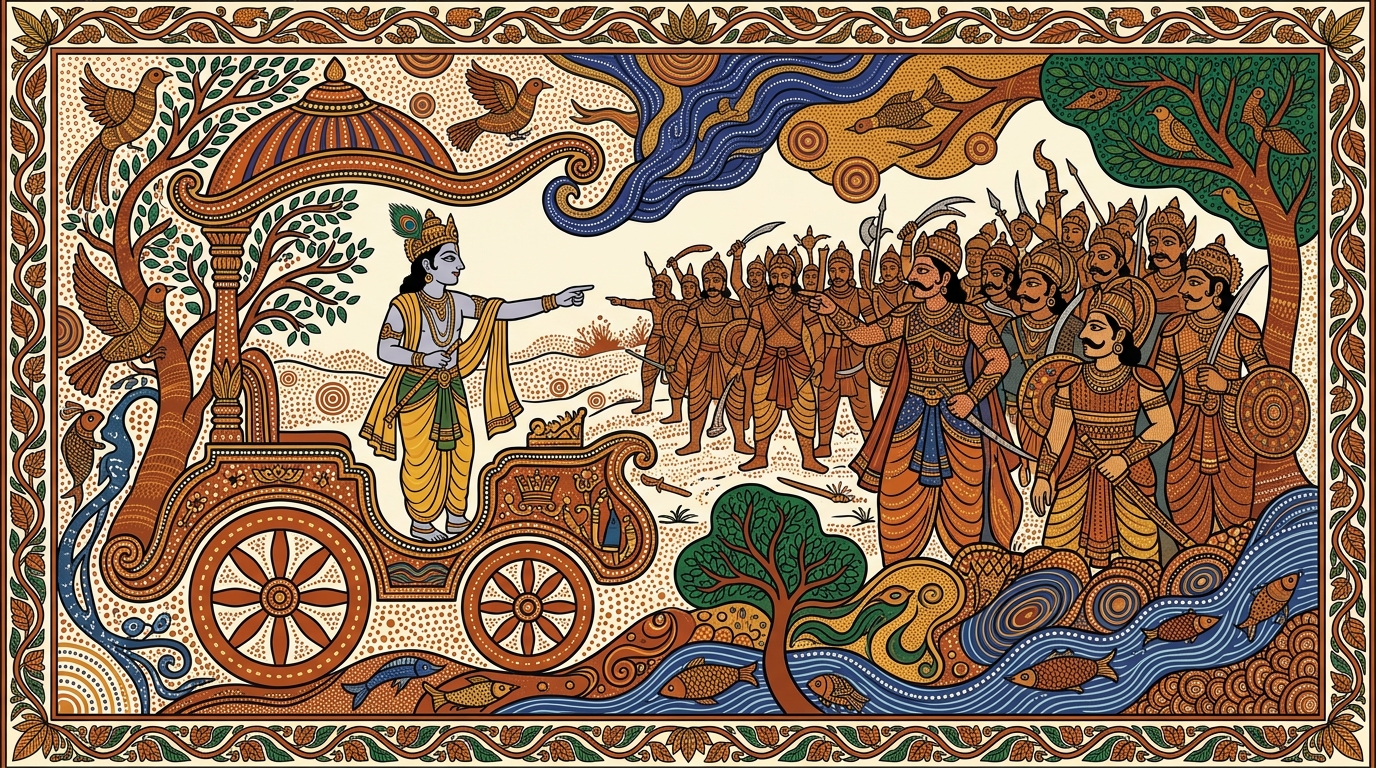
Krishna painted the picture with words, and each word landed like
an arrow.
"Imagine this," he said. "The battle begins. Conch-shells scream.
The armies charge. Dust rises from a million feet, thick as
monsoon clouds, turning the morning dark. And in the middle of
that roar, Bhishma, the grandsire, the greatest warrior alive,
looks across the field for the one chariot he respects above all
others. Yours."
Arjuna's throat was dry.
"He does not find it. The white horses are gone. The Gandiva bow
is gone. The banner with the Hanuman crest is gone. He looks left,
looks right, squints through the dust — nothing. And then someone
rides up beside him and says: Arjuna has left."
Krishna let the sentence sit.
"What do you think happens on Bhishma's face? The man who taught
you to ride a horse before you could tie your own dhoti? I will
tell you what happens. His jaw goes tight. His eyes go flat. And
he says nothing — because there is nothing to say. The grandson
he loved, the warrior he was proud to face even as an enemy, has
turned and gone."
Krishna turned slightly, pointing toward the other end of the
Kaurava line.
"And Drona. Your Guru. The man who kept you after every practice
session, who pushed you harder than any other student because he
saw in you something that appears once in a generation. He will
stand in his chariot and stare at the empty place where you were
supposed to be. And what he will feel is not anger. It is the
thing that comes after anger — the quiet, heavy realization that
he was wrong about you."
Arjuna's hands were shaking. Not with fear now — with something
sharper. The image of Bhishma's flat eyes. The image of Drona's
silence. The empty space on the battlefield where his chariot
should have stood, conspicuous as a missing tooth.
"They esteemed you, Arjuna. They honored you as an equal, as a
worthy opponent. And the distance between that esteem and the
contempt they will feel if you leave — that distance is a fall
from which no man recovers."