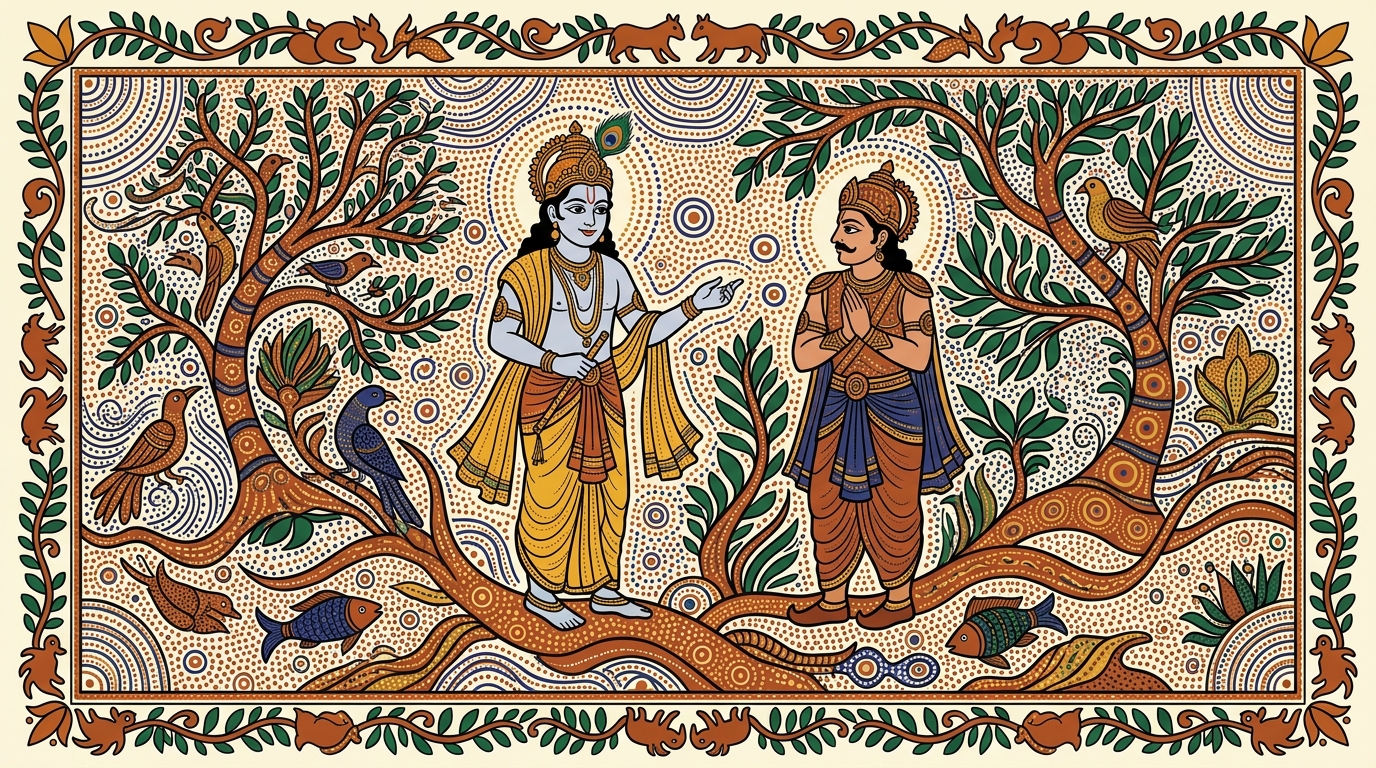
The tone changed. Like a season turning.
Up to now, Krishna had been a philosopher — patient, circling,
approaching the truth from one angle and then another, giving
Arjuna room to think. But with this verse, the charioteer
straightened his back, and when he spoke again, his voice had the
edge of a blade being drawn from its sheath.
"Enough about the soul," he said. "Let us talk about you."
Arjuna blinked.
"You are a Kshatriya." Krishna said the word the way a blacksmith
says iron — naming a material, not offering a compliment. "Your
father was Pandu, a warrior king. Your grandfather was a warrior.
Your teacher Drona, the man standing over there with an arrow
already nocked, spent thirty years shaping you into the finest
archer the world has seen. You did not stumble into this life,
Arjuna. You were forged for it."
A war-horse in the Pandava line stamped and snorted, as if
agreeing.
"Every person is born into a particular shape," Krishna continued.
"Not the shape of their body — the shape of their purpose. A
healer heals. A teacher teaches. A builder builds. And a warrior
protects. That is svadharma — your own dharma, the duty that
belongs to you and no one else, the work that fits your hands
like a bow fits yours."
He gestured at Gandiva, lying across Arjuna's knees. The great
bow seemed to hum faintly, as though it recognized itself in
Krishna's words.
"When a righteous battle comes to a warrior's door — when the
cause is just, when the enemy has refused every offer of peace,
when innocent people stand to suffer if no one acts — there is
nothing higher a Kshatriya can do than fight. Not because
fighting is good. Because the protection fighting provides is
good. Because the dharma it upholds is good."
Krishna's eyes were steady, unblinking, dark as river stones.
"You are not being asked to enjoy this. You are being asked to
recognize what you are and do what that requires. A lamp does not
choose whether to give light. It is a lamp. You, Arjuna, are a
warrior. This is your war. Do not waver."