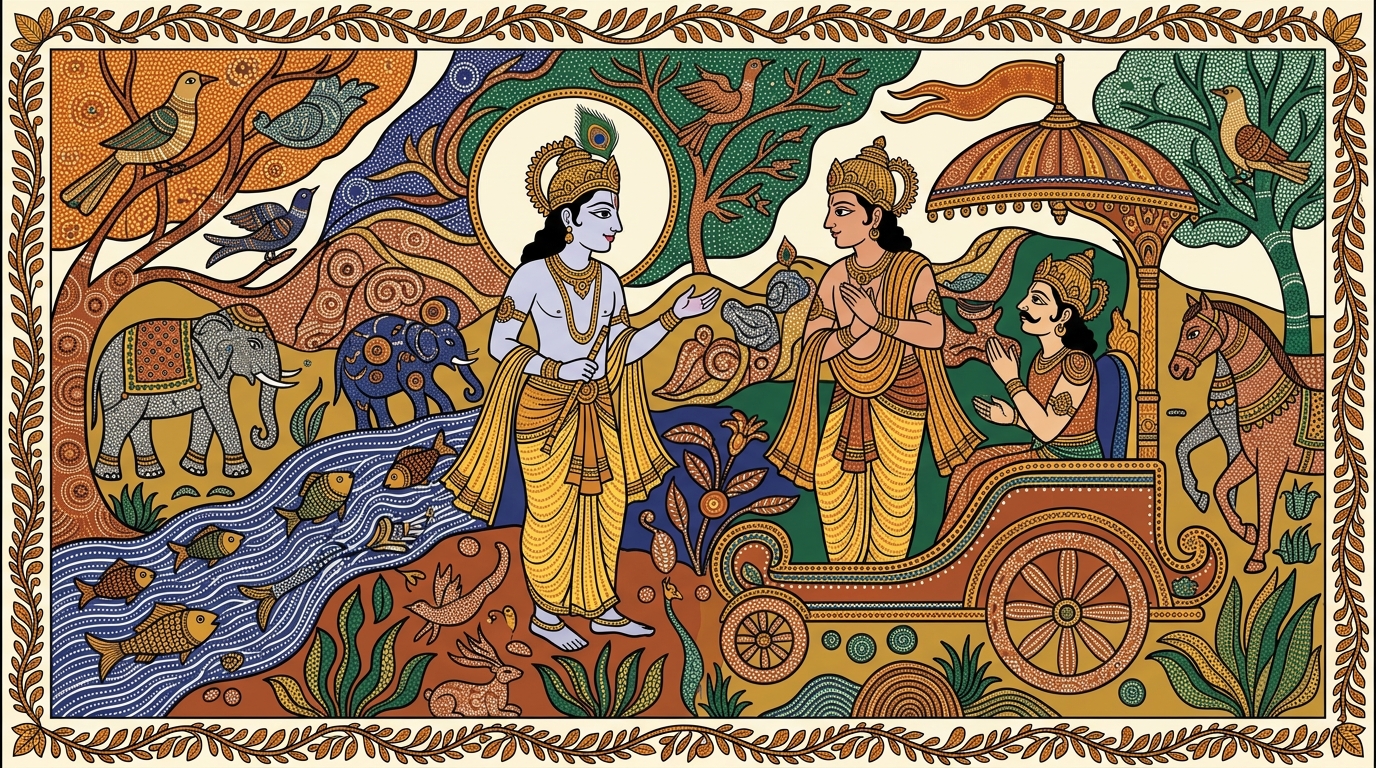
Krishna paused. He let the silence after verse 20 stretch and settle,
the way a singer lets the last note of a raga dissolve into the air
before beginning the next phrase. Then he leaned forward, and his
voice became quiet, almost intimate, as though he and Arjuna were
not on a battlefield at all but sitting on a riverbank somewhere,
two friends talking late into the night.
"Think about what I have just told you," he said. "Really think."
Arjuna looked at him. The tears on his cheeks had dried. His
breathing had steadied. Something was working behind his eyes,
the slow machinery of understanding, turning.
"If the soul cannot be destroyed," Krishna said, "then tell me,
Partha — who exactly are you afraid of destroying?"
The question hung in the air like a hawk on a thermal.
"If the soul is never born, it cannot die. If it is eternal, no
weapon can end it. If it is imperishable, no fire, no flood, no
war, no passage of a thousand ages can diminish it by a single
grain. You know this now. I have shown you. So — "
He spread his hands, palms up, as though the answer were resting
there, obvious, waiting to be picked up.
"How can a person who truly understands this — not just hears it,
not just nods at it, but knows it in the marrow of his bones —
how can that person believe he is killing anyone? How can he believe
anyone is being killed?"
It was not a riddle. It was not a trick. It was the simplest kind
of logic: if A is true, then B cannot be. If the soul is
indestructible, then destruction of the soul is impossible. And if
destruction of the soul is impossible, then the thing Arjuna feared
— that by fighting he would annihilate the people he loved — was
a fear built on a misunderstanding. A fear of something that could
not happen.
Krishna was not dismissing Arjuna's grief. He was showing Arjuna
that the grief was aimed at the wrong target. You are mourning a
death that cannot occur. You are afraid of a loss that is not
possible. The bodies will fall — yes. But the beings inside them?
They were here before this battle and they will be here long after
the last sword has rusted into the earth.
Arjuna closed his eyes. The logic was airtight. Gentle, but
relentless. Like water finding every crack in a stone wall, it
seeped into the places where his fear lived and dissolved them.