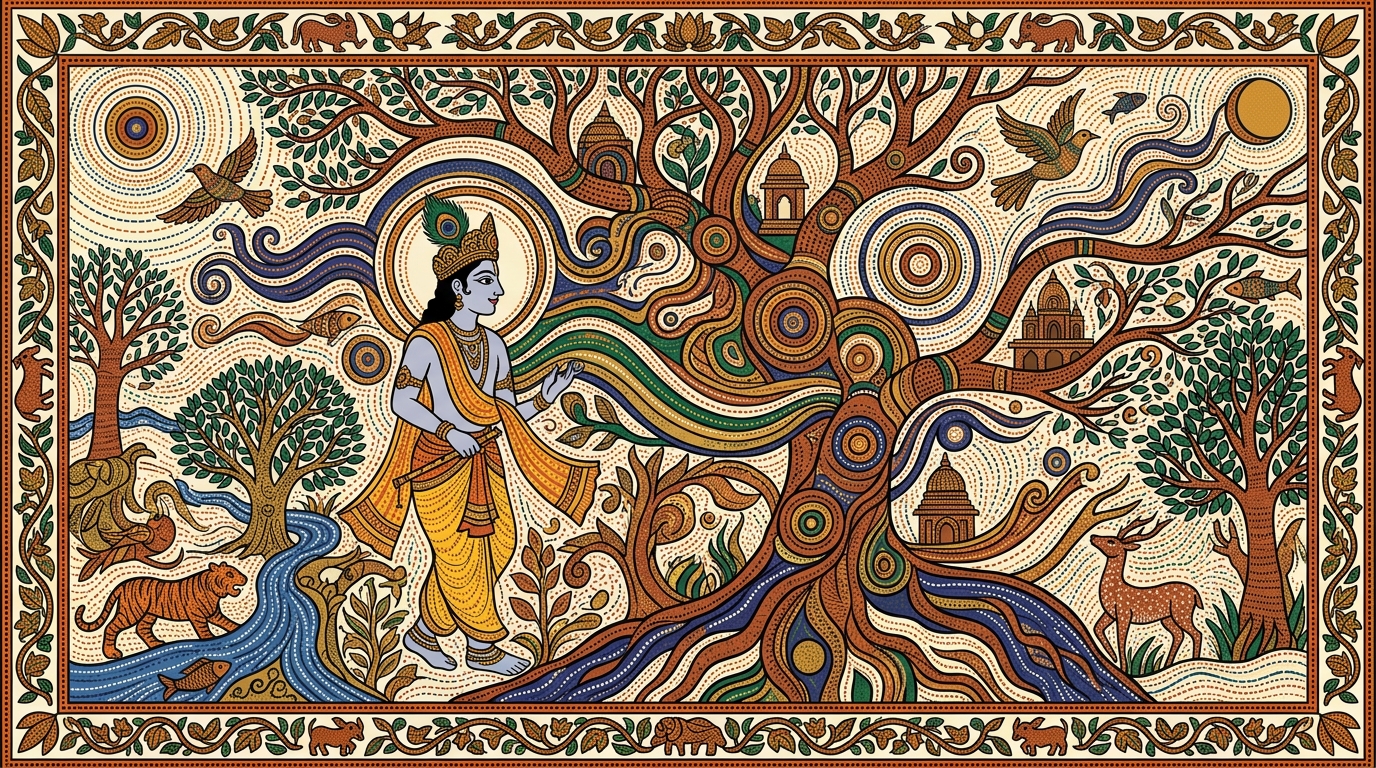
There was a king named Hiranyakashipu who believed he had conquered
death.
Through terrible austerities, standing on one foot for years while
termites built mounds around his body and fire ants crawled across
his skin, he had won a boon from Brahma. No man or beast could
kill him. Not indoors or outdoors. Not by day or by night. Not by
weapon or by hand. He looked at this fortress of conditions and
decided he was God.
But his son, Prahlada, knew something the king did not.
Prahlada was five years old. He had large, calm eyes that looked at
you as though they could see the space behind your thoughts. When
his tutors taught him the arts of power — how to tax, how to
punish, how to make an enemy kneel — Prahlada listened politely
and then said, "But none of this is real. Only Narayana is real.
Only the Self that shines in every creature."
This drove Hiranyakashipu to a rage so white-hot that the palace
walls trembled. He ordered his soldiers to throw the boy off a
cliff. Prahlada fell — and landed softly, as though the air itself
had caught him. He ordered poisonous snakes released into the boy's
room. The snakes coiled around Prahlada's ankles and slept. He
ordered war elephants to trample the child. The elephants stopped,
knelt, and touched their trunks to Prahlada's feet.
Then Hiranyakashipu ordered the fire.
His sister Holika had a boon — a cloth that made her immune to
flame. She sat on a pyre of sandalwood and ghee-soaked logs,
Prahlada in her lap, and the priests lit the fire. The flames
rose — orange, gold, roaring — and the heat was immense, enough
to melt iron, enough to turn stone to powder.
Prahlada closed his eyes. He did not pray for rescue. He did not
think of escape. He thought: I am not this body. What I am cannot
be burned, because what I am is the same awareness that looks
through every eye in every creature in every world. Fire cannot
touch it, because fire itself exists within it.
The wind shifted. Holika's fireproof cloth flew from her shoulders
and wrapped itself around Prahlada. She burned. He did not. When
the fire died and the smoke cleared, the boy sat in a circle of
warm ash, unharmed, his eyes still closed, his breath as steady
as a sleeping river.
The soldiers stared. Hiranyakashipu stared. And Prahlada opened
his eyes and said, gently, the way you might explain something
obvious to someone you love: "Father, He is everywhere. In the
fire that tried to burn me. In the ash beneath me. In you. There
is nothing in all this world that He does not pervade, and what
He pervades, nothing can destroy."