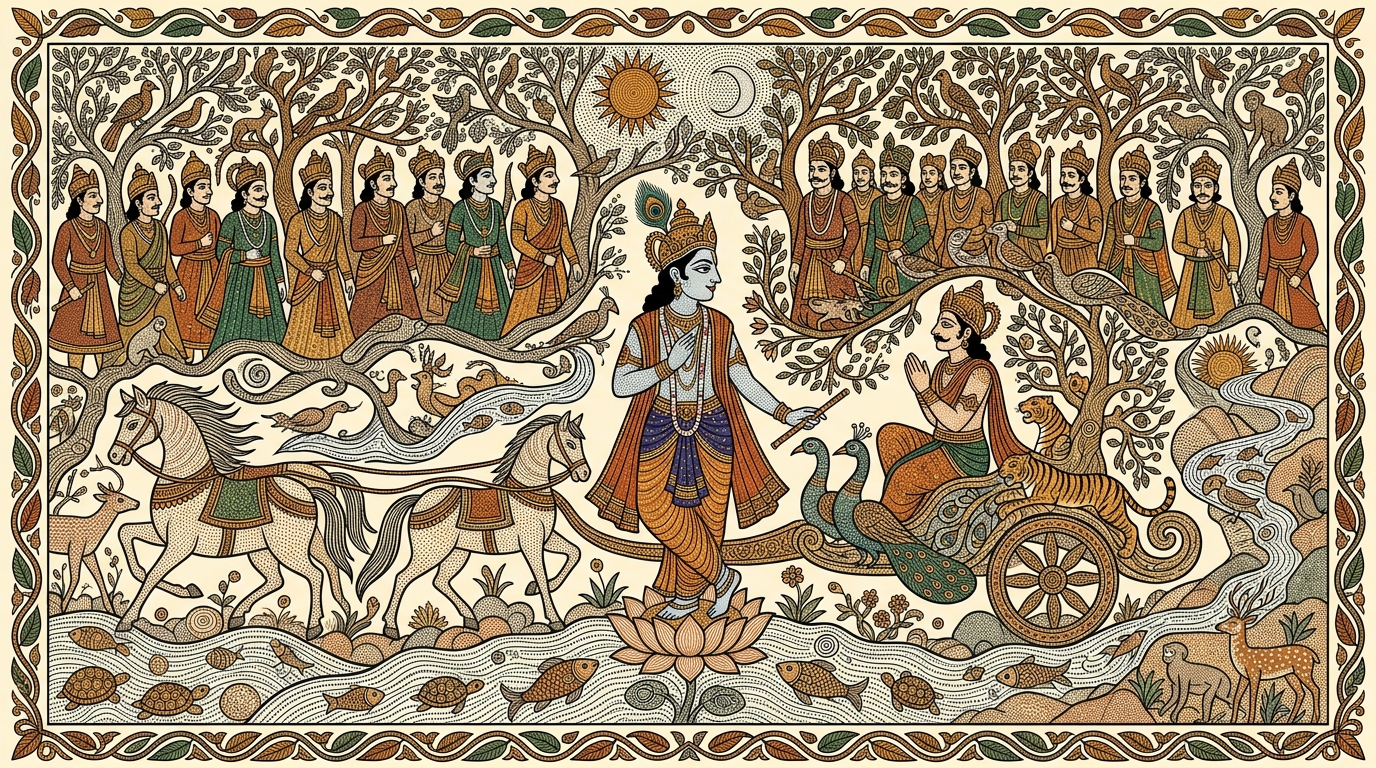
Krishna lifted one hand and swept it across the horizon.
"Look," he said.
Arjuna looked. He saw the two armies stretching across the plain of
Kurukshetra like two great tides about to crash together. He saw
banners snapping in the wind, the palm tree of Bhishma's division,
the golden lion of Drona's. He saw foot soldiers adjusting their
leather armor. He saw elephants swaying, their painted foreheads
bright in the morning sun. He saw chariots beyond counting.
And he saw faces. Bhishma, who had held him on his lap when he was
small enough to fit in the crook of one arm. Drona, who had placed
Arjuna's first bow in his hands and shaped those hands around the
grip until the bow felt like a part of his own body. Kripa, who had
taught him the constellations on summer nights, pointing upward from
the palace roof while fireflies drifted past them like fallen stars.
"You think," Krishna said quietly, "that today is the day these men
might end."
Arjuna's jaw tightened. He said nothing.
"But there was never a time when Bhishma did not exist. There was
never a time when Drona was not. There was never a time when you,
Arjuna, were nothing." Krishna paused, letting the words settle like
dust after a passing cart. "And there will never be a time — never —
when any of us cease to be."
It was a staggering thing to say. Arjuna's mind stumbled on it the
way a foot stumbles on a root hidden in tall grass. Never a time? He
thought of his own earliest memory, being three years old, watching
rain pour off the palace eaves, and tried to imagine before that.
Before his birth. Before his mother's birth. An endless corridor of
existence stretching backward into darkness, with no beginning, no
first door.
And then forward. Past today, past the battle, past old age and
death, existence continuing, the same way a river continues past
every bridge that crosses it.
"These bodies you see," Krishna said, "are like clothes worn for a
season. But the ones wearing them — you, me, every king and soldier
on this field — we are older than the sun. And we will be here long
after the sun has gone dark."
The morning light seemed to thicken around the chariot, as if the air
itself were listening.