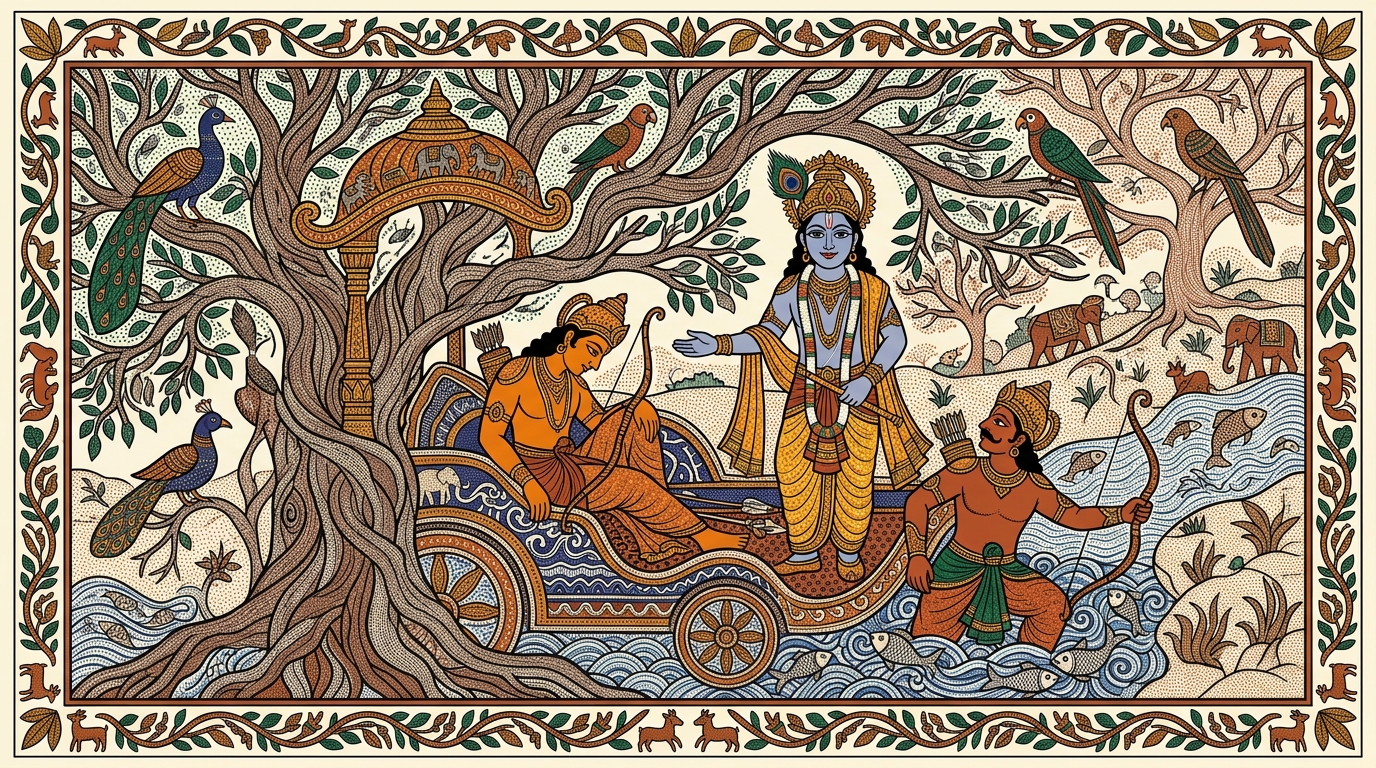
In the old language of the Gita, Krishna calls Arjuna two names in
this single verse, and both of them are deliberate. First, "Partha,"
son of Pritha, which is another name for Kunti, Arjuna's mother. Then,
at the very end, "Parantapa," scorcher of foes.
One name says: I know where you come from. The other says: I know what
you are capable of.
There was a girl in Varanasi named Aisha who played tabla. She had been
playing since she was six, taught by her grandfather, a man who had
performed at Banaras Hindu University and once, in 1978, at a small
concert where Zakir Hussain was in the audience. Her grandfather's
hands were knotted with age now, his fingers stiff as winter branches,
but he could still produce a sound from the bayan that made the walls
of their narrow house hum.
Aisha was fourteen when she was invited to perform at the school's
annual day — a solo tabla recital, five minutes long, in front of six
hundred students and their parents. She had prepared for weeks. She
knew the composition by heart. She could play it in her sleep.
But on the day, standing backstage with the tabla in her lap, she
froze. Through the curtain she could hear the audience rustling and
coughing. She smelled floor polish and marigolds. Her fingers went
cold. Her mind went blank. She could not remember the first beat.
Her grandfather was sitting beside her on a plastic chair. He watched
her face change. He watched the color drain from her cheeks. And then
he did something unexpected. He did not pat her hand. He did not say
"you'll be fine." He straightened his back, looked her dead in the eye,
and said:
"Aisha. Your great-grandmother carried water from the Ganga every
morning for forty years and never once complained about the weight.
Your mother argued her way into college when the whole family said no.
And you — you have my hands."
He held up his gnarled fingers. She looked at her own smooth ones.
"This is not you," he said. "This shaking, this hiding — this is
someone else. You are Parantapa. You burn through difficult things.
Now stand up and go."
She went. Her fingers found the first beat, and after that they
remembered everything.
"Uttishtha Parantapa" — Arise, O scorcher of foes. Krishna is not
giving Arjuna a pep talk. He is giving him back his name. He is
saying: the person sitting here weeping is not the real you. The real
you burns through obstacles. Stand up and be that person again.
Sometimes the bravest thing someone can say to you is: I refuse to
let you forget who you are.